




Arbitration in the Gulf: A five-year review

An analysis by Emma Tormey, Celia Johnson-Morgan and Cynthia Abi-Chahine of Ashurst on the region’s evolution as an arbitration hub, with stronger institutions, modernised rules and courts increasingly enforcing awards.
Over the last five years, the Gulf has experienced remarkable geopolitical change, economic diversification and rationalisation, coupled with rapid technological advancement. These shifts are reflected in regional arbitral trends, including significantly increased caseloads, the launch of new institutions and changes in the types and values of claims, as well as the identity of involved parties. To keep up, regional arbitration institutions have expanded and reformed, and the local courts have generally become more ‘arbitration-friendly’, with pro-enforcement trends being documented.
2026 also marks five years since Dubai Decree No. 34 of 2021 (Decree 34) was introduced in the United Arab Emirates (UAE), which abolished the DIFC-LCIA and Emirates Maritime arbitration centres and positioned the Dubai International Arbitration Centre (DIAC) as Dubai’s leading arbitral institution – making this a natural point to examine how the arbitration landscape in the Middle East, and particularly the Gulf, has matured and evolved in recent years.
OVERVIEW OF GULF ARBITRAL INSTITUTIONS
The Gulf hosts a growing number of internationally recognised arbitral institutions, including:
UAE
DIAC, founded in 1994, is one of the region’s most well-established institutions. Following the introduction of Decree 34, DIAC inherited a substantial caseload from the now-abolished DIFC-LCIA and Emirates Maritime arbitration centres. In 2024, the total amount in dispute in DIAC-administered arbitrations reached approximately USD 2.6 billion. In 2025, the Global Arbitration Review (GAR) ranked DIAC as the tenth most active arbitration centre worldwide, with Dubai placed as the fifth most popular seat globally by case volume.
The Abu Dhabi International Arbitration Centre (ArbitrateAD), the newest institutional entrant in the Gulf, commenced operations in February 2024. ArbitrateAD replaced the Abu Dhabi Commercial Conciliation and Arbitration Centre (ADCCAC). Within its first year, ArbitrateAD received the ‘Arbitral Institution That Impressed’ award at the 2025 GAR Awards in Paris. ArbitrateAD has also gained traction with government bodies in the UAE. In June 2025, ArbitrateAD signed a Memorandum of Understanding with the Abu Dhabi Ports and Infrastructure Cluster (ADPIC). Under this agreement, ArbitrateAD will serve as the official appointing authority for adjudicators and for members of the dispute avoidance and adjudication boards under ADPIC’s Capital Projects Standard Contracts.
Kingdom of Saudi Arabia (KSA)
The Saudi Centre for Commercial Arbitration (SCCA) has been operating since 2016. Over the last five years, it has become a leading institution in the Gulf, particularly for parties operating in KSA, recording a 30 per cent increase in filings in 2024. It has also entered into strategic international partnerships, including with the Singapore International Arbitration Centre (SIAC), to work collaboratively on different initiatives.
Qatar
The Qatar International Centre for Conciliation and Arbitration (QICCA) has maintained a consistent caseload since its inception in 2006. According to GAR, QICCA administered 86 arbitration cases in 2024, with a total value exceeding QAR2 billion. QICCA also manages a smaller number of mediation and conciliation cases.
Bahrain
The Bahrain Chamber for Dispute Resolution (BCDR) was established in 2009. In 2022, the BCDR amicably concluded its 13-year partnership with the American Arbitration Association and introduced new arbitration rules. BCDR now operates as a fully independent, self-sufficient institution. In March 2022, BCDR also launched a specialised Sports Arbitration Rules to cater to the growing sports sector in the region.
The trajectory of these institutions reflects the broader maturation of the Gulf as a domestic and international dispute resolution hub, with growing caseloads demonstrating competition to gain a share of the international arbitration market.
OVERVIEW OF REFORMS TO INSTITUTIONAL RULES OVER THE LAST FIVE YEARS
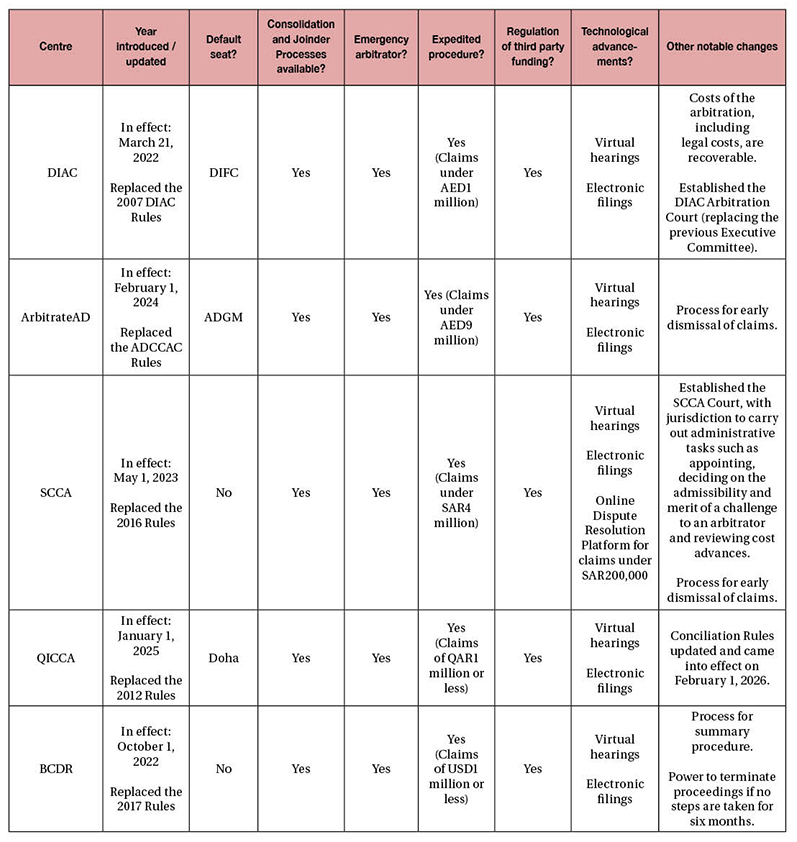
Over the last five years, arbitral centres across the region have revised and modernised their rules, bringing them in line with best practice (see below table).
Certain arbitration laws in the Gulf have also been reformed or are in the process of reform, including the anticipated enactment of the new KSA Arbitration Law, which is expected to reinforce Saudi Arabia’s position in the region’s arbitration landscape.
Further, each of the key centres in the region embraces the use of technology, with AI and digitalisation reshaping arbitration practice in the Gulf and the wider arbitration community. For example, in 2025, DIAC partnered with Opus 2 (a hearing service provider) and Jus Mundi (an AI-powered research platform) to support AI-assisted case management, modern hearing technologies and legal research. DIAC also recently announced the launch of “DANA by DIAC”, a digital arbitration platform for centralised e-filing, case registration, document submission and case management. The SCCA has very recently strengthened its partnership with Jus Mundi to operationalise AI across the SCCA’s systems and processes.
INTRODUCTION OF EMERGENCY RELIEF IN THE GULF
The key Gulf institutions introduced mechanisms to appoint emergency arbitrators over the last five years. However, exercising emergency relief options is not always straightforward. To be effective, emergency relief must be quickly obtainable, readily enforceable and capable of binding third parties.
While institutions in the Gulf have made commendable efforts to address these limitations – such as the inclusion of a without-notice procedure in the DIAC Rules – parties still find that courts remain the better option when speed and enforceability are key. Emergency arbitration is a valuable tool for certain circumstances, but does not replace judicial interim relief.
Enforceability remains an issue. The approach taken by local courts in the Gulf to interim relief granted by emergency arbitrators is a developing area, with decisions often considered “interim” rather than “final”. Most arbitration laws in the Gulf do not currently provide for emergency arbitration. The ADGM Arbitration Regulations 2015 and the draft KSA arbitration law include emergency arbitrators within the definition of “arbitral tribunal”, although they do not establish a specific framework governing emergency arbitration. By contrast, regional institutional rules uniformly provide for emergency arbitration while the New York Convention is silent on enforceability.
Recent case law suggests a more supportive approach. The DIFC Court of Appeal recently confirmed that interim and provisional awards are enforceable, which should extend to the decisions of emergency arbitrators (see: Neal v. Nadir [2024] DIFC CA 001), and the onshore UAE Courts have taken a similar approach.
ENFORCEABILITY OF ARBITRAL AWARDS BY GULF COURTS
A key benefit of international arbitration is the ease of enforcement of arbitral awards, particularly under the New York Convention. The local courts in the Gulf have increasingly become much more experienced in arbitration, including the enforcement of domestic and foreign arbitral awards.
Taking KSA as an example, the Saudi Justice Minister Walid Al-Samaani emphasised at the Third Saudi Commercial Arbitration Conference that Saudi Arabia had become “among the fastest countries in the world in enforcing arbitral awards”.[1]
The UAE is also generally becoming more pro-arbitration and enforcement. The Dubai Court of Cassation recently clarified that, when considering the enforceability of foreign arbitral awards, the grounds for refusal are confined to those set out in the New York Convention. Importantly, the Court found that the requirements of Article 222 of the UAE Civil Procedure Code do not apply to the enforcement of foreign arbitral awards (Cassation Judgment Nos. 778 and 887 of 2025).
That said, the abolition of the DIFC-LCIA and ADCCAC has raised questions as to the continued enforceability of awards rendered under legacy arbitration agreements. While the position is now relatively settled in the UAE, with both the DIFC Courts and the onshore UAE Courts enforcing arbitral awards in these circumstances, there remains a question as to how Courts outside of the UAE will treat impacted awards, with variable decisions being issued on this matter in courts around the world, including Singapore, the Cayman Islands and the USA. However, the trend of the international decisions indicates that courts are willing to enforce awards where parties have unequivocally submitted to the jurisdiction of a tribunal, even if the arbitration was administered by an institution other than that specified in the arbitration agreement.
CONCLUSION
The past five years have demonstrated the Gulf’s remarkable evolution as an international arbitration hub. Despite various challenges, the region’s arbitral institutions have grown in caseload, sophistication and global standing. Significant rule reforms, legislative modernisation, and technology integration reflect a clear commitment to aligning with international best practices. The Gulf is no longer an emerging market for arbitration, but an increasingly central player in the global dispute resolution landscape.
Looking ahead, we can expect to see additional reforms to further modernise the region’s arbitration offering. Local courts are also demonstrating an increasing willingness to uphold and enforce arbitral awards, a trend which is likely to continue and further increase party confidence in selecting Middle Eastern seats for arbitrations. Finally, the current conflict in the region will undoubtedly have a tangible impact on the disputes landscape going forward. We can expect to see a number of disputes crystallise in the next few years as a direct result of the conflict. These may include disputes arising out of supply chain disruption and project delays, as well as insurance disputes.
Text by:

- Emma Tormey, partner, Ashurst
- Celia Johnson-Morgan, senior associate, Ashurst
- Cynthia Abi-Chahine, associate, Ashurst
Footnotes:
[1] https://www.moj.gov.sa/English/MediaCenter/news/Pages/NewsDetails.aspx?itemId=1017