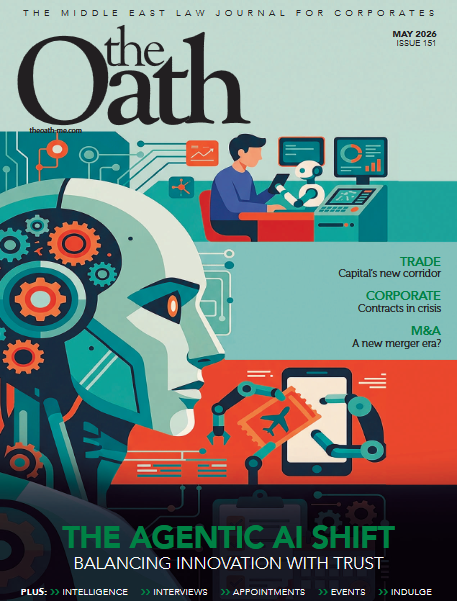





Accountability in the age of agentic AI

The UAE’s AI ambition is bold, and delivering it responsibly will depend on robust governance, clear accountability and legal foresight. Konexo examines the practical implications for legal teams shaping this next phase.
Agentic AI, in simple, non-technical terms, refers to AI systems capable of mimicking human-like reasoning and decision-making. This marks a significant evolution beyond traditional task automation, as it places a higher degree of trust in AI outcomes with reduced levels of direct human intervention.
Against this backdrop, the UAE government’s ambition to deploy agentic AI across 50 per cent of its operations within the next two years represents far more than a technology upgrade. It signals a fundamental structural shift in how decisions are made, how roles and responsibilities are defined, and how trust between government and the general public is maintained at a time of rapid global technological transformation.
FROM VISION TO EXECUTION
“AI will be our government executive partner to support decisions, enhance services, boost operational efficiency, and evaluate results in real time.” – H.H. Sheikh Mohammed bin Rashid Al Maktoum, Vice President and Prime Minister of the UAE and Ruler of Dubai, UAE Cabinet Meeting, 23 April 2026
The UAE’s stance on agentic AI within government is positive, bold, and forward-looking, underpinned by a genuine ambition to use AI for the greater good. The critical challenge now lies in translating this vision into practical outcomes. Key considerations include identifying impactful and achievable use cases, ensuring scalability, establishing robust accountability and governance mechanisms, and assessing impacts on the public and return on investment. These factors will be central to the success of the proposed two-year implementation roadmap.
ACCOUNTABILITY IN AN AGENTIC AI ENVIRONMENT
The deployment of agentic AI introduces a longstanding challenge with renewed urgency: accountability. When decisions are supported or driven by AI, where does responsibility ultimately sit? Is it with the human designers, the deployers, or the organisation itself? How is liability determined if outcomes cause harm? How can meaningful human oversight be demonstrated, and who remains accountable for ensuring actions taken by the agent prioritise human safety and public interest?
These questions highlight that the challenge extends beyond technology implementation to the broader governance of AI systems. For Legal functions, this requires a re-evaluation and evolution of existing legal frameworks to properly account for the risks introduced by agentic AI. Mitigation strategies must align with the UAE’s broader vision of balancing innovation with trust, care, and societal benefit.
To be effective, AI governance frameworks must be developed collaboratively. Legal functions should work in close alignment with technology, risk, and other business stakeholders involved in shaping responsible AI use. Such frameworks should clearly govern development, deployment, and ongoing monitoring, supported by shared ownership, coordination, and a consistent understanding of risk. Senior Management endorsement is essential, alongside clear alignment with the organisation’s risk appetite and well-defined roles and responsibilities across business functions.
THE CASE FOR CLEAR AI REGULATION IN THE UAE
While the UAE has consistently taken a proactive approach to AI guidance through principles and national strategies, greater legal clarity is now required. In particular, there is a need for a formal governance and regulatory framework that addresses the deployment of agentic AI, drawing on established international practices such as those reflected in the EU AI Act.
A regulation aligned with the UAE’s ambitions would provide guardrails for managing AI risks while enabling innovation. By clearly defining expectations around risk classification, accountability, and oversight, such a framework would support a more structured and confident adoption of agentic AI and other emerging technologies.
As seen in leading global AI governance models, progress in AI is strongest where advancements in technology are matched by advances in regulation. An enabling regulatory framework allows organisations to manage risk, demonstrate compliance, and build trust. This is particularly important in government environments, where trust underpins relationships with citizens, residents, businesses, and international stakeholders. Legal certainty serves as a cornerstone for sustaining this trust.
For organisations operating within or alongside government, AI deployment should therefore begin with a clear understanding of legal obligations. Legal and regulatory considerations must be prioritised at the design and implementation stage, not addressed retrospectively. The key takeaway is clear: legal requirements should be embedded from the outset, not treated as an afterthought.
THE ROLE OF DATA PRIVACY AND DATA GOVERNANCE TO ENABLE AI REGULATION
Data remains the foundation upon which AI systems are built. How data is governed, protected, managed, and secured directly influences the reliability, fairness, and transparency of AI outcomes. These principles should sit at the core of government-led AI initiatives.
With the UAE already engaged in advanced discussions on a federal data privacy framework, finalising this regulation with clear compliance timelines and implementation guidance is critical. This is particularly important for core privacy principles such as lawful basis, purpose limitation, transparency, and accountability. These guardrails enable AI systems to operate effectively and responsibly at scale, especially in public sector and highly regulated environments where data sensitivity is high and the consequences of misuse are significant.
Strong data governance also ensures AI systems are built on accurate, consistent, and reliable data. This enhances model performance, reduces unintended outcomes, supports consistent decision-making, and builds trust with internal and external stakeholders. Effective data governance includes clearly defined data ownership, robust master data management, and controls for data integrity, security, and accountability. Transparency in how data is collected, used, and shared remains a critical factor in sustaining trust.
As AI capabilities evolve, data privacy and governance will continue to grow in legal and strategic importance. Organisations that invest early in these foundations will be best positioned to unlock value while maintaining compliance and public confidence.
IMPLICATION AND RISING EXPECTATIONS ON LEGAL FUNCTION
Given the evolving needs of governing AI, legal function would need to update their ways of working:
- Cross-functional collaboration
Legal teams are increasingly expected to act as trusted advisors, working proactively with risk, data, cyber, IT, and internal audit functions to shape responsible and compliant AI deployment. This represents a shift away from reactive, case-by-case advice towards an embedded role within the governance framework. Collaboration must be ongoing, proactive, and integral to day-to-day decision-making.
- Board oversight and accountability
Given the strategic and ethical risks associated with AI, legal leadership should be adequately represented across governance forums. Heads of Legal should regularly engage with boards and executive teams to advise on how AI is being deployed in a compliant and responsible manner.
- Capability transformation
Data and AI literacy is now a critical capability for legal teams. Upskilling in AI concepts, applications, and associated risks enables meaningful dialogue with technology and business stakeholders and helps translate legal requirements into practical, actionable outcomes. This capability shift supports legal functions in acting as enablers of innovation rather than constraints, aligning legal judgement with business risk appetite and strategic ambition in coordination with multiple disciplines across the business: IT, information security, data protection, procurement, risk and compliance, etc.
Ultimately, in-house legal teams are evolving from advisors to architects of governance. Their ability to bridge legal, operational, and technological perspectives will play a decisive role in how successfully organisations navigate the opportunities and risks of AI adoption.
LOOKING AHEAD
The UAE stands at a pivotal moment. Its proactive approach to deploying AI across government operations, underpinned by a strong governance foundation, has the potential to become a global reference point for responsible AI adoption.
A governance model that is clear, pragmatic, and supportive of innovation can provide government, citizens, and businesses with a shared roadmap for AI deployment. If these elements align, the UAE is well placed to build a leading digital government, setting new standards for trust, accountability, and responsible innovation. This demonstrates that governance and innovation are not competing priorities, but mutually reinforcing enablers of sustainable and ambitious progress.
In effect, the two-year plan prepared by the UAE government provides sufficient time for in-house legal teams to upskill on data and AI literacy, while determining the impact of agentic AI on their business function.
Contributors: Richard Chudzynski, partner and Skanda Reddy, senior consultant at Konexo (Eversheds Sutherland)
Text by:

Aben Pagar, head of digital risk consulting, Konexo (Eversheds Sutherland)