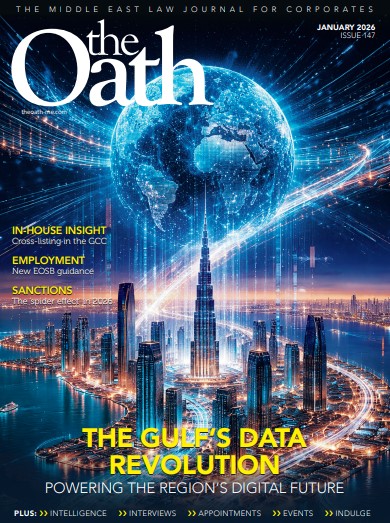





Cross-listing in the GCC

As GCC markets mature, cross‑listing is increasingly used to enhance visibility, liquidity and regional integration. This article explores such evolving frameworks in Bahrain and the UAE, with insights from Gaby Samir El Hakim, Maha Alkhabbaz and Hesham Bucheeri of NBB.
Cross-listing has moved from being a niche capital markets exercise to a mainstream strategic tool, particularly for issuers operating in, or seeking access to, multiple jurisdictions. At its simplest, cross-listing involves a company listing the same class of shares on more than one stock exchange. In practice, the concept sits on a spectrum, ranging from full equity dual listings to secondary or technical listings to listing depository instruments, each designed primarily to enhance liquidity and investor access rather than just to raise fresh capital.
Globally, cross-listing has been driven by a convergence of regulatory standards, improvements in market infrastructure and a growing expectation from institutional investors that credible issuers should be accessible across borders. Established examples include listings spanning New York, London, Hong Kong and Singapore, but the model is increasingly finding traction closer to home as GCC markets mature and seek to align themselves with international capital markets practice.
For banks and other financial institutions in particular, cross-listing is often less about a single liquidity event and more about long-term positioning: increasing visibility, diversifying the shareholder base and reinforcing transparency and disclosure credentials. In the GCC context, it also reflects a broader policy push towards market deepening, regional integration and the development of capital markets as a genuine alternative to traditional bank financing.
REGULATORY AND MARKET CONTEXT
In Bahrain, the capital markets framework is anchored around the Bahrain Bourse, with oversight from the Central Bank of Bahrain. Listing requirements, ongoing disclosure obligations and corporate governance standards are broadly aligned with international norms, particularly for financial institutions and public companies.
In the UAE, the landscape is more fragmented. Issuers may be considering listing on the Abu Dhabi Securities Exchange (“ADX”), the Dubai Financial Market (“DFM”) or Nasdaq Dubai (“ND”), each of which operates within a distinct regulatory and investor ecosystem. While the Capital Market Authority (“CMA”), formerly the Securities and Commodities Authority, sits at the federal level and regulates both the ADX and the DFM, each exchange has its own rules and Nasdaq Dubai is regulated by the Dubai Financial Services Authority (“DFSA”). Accordingly, practical listing processes, disclosure mechanics and post-listing engagement differ between markets.
STRATEGIC RATIONALE
Cross‑listing has recently gained momentum in the region, illustrated by high‑profile IPOs that pursued simultaneous listings across multiple Gulf exchanges. With growing market integration and increasing interest from both issuers and investors, more companies across the GCC are reportedly exploring similar dual‑listing strategies as part of their capital‑raising and expansion plans.
At a strategic level, the most compelling case for cross-listing remains access to a broader and more diversified investor base, particularly if the issuer operates in both markets. Multiple listings can materially improve liquidity by increasing trading volumes, reducing trading costs, narrowing bid-ask spreads, decreasing reliance on a single market’s trading dynamics, and lowering trade barriers. That said, if one exchange is larger than the other, there is a risk that trading will migrate to the larger of the two exchanges which may negate some of the reasons for seeking a cross-listing.
Visibility is another key driver. A presence on more than one exchange can significantly enhance brand recognition and international profile. In practice, this can translate into improved price discovery and a more robust valuation and benchmarking framework.
From a funding perspective, cross-listing can support access to cheaper capital. It also provides optionality, allowing issuers to respond more flexibly to market conditions when funding opportunities arise.
Finally, there is a signalling effect. Cross-listing often reinforces a company’s commitment to transparency, governance and regulatory engagement. For well-run issuers, this can be a competitive advantage rather than a compliance burden, particularly in markets where institutional investors place a premium on governance quality.
LISTING ELIGIBILITY AND REQUIREMENTS
Abu Dhabi Securities Exchange
Numerous listing requirements apply to the ADX, mainly that only a Public Joint Stock Company or a Freezone Public Limited Company is permitted to list on the ADX. Minimum issued capital and paid-up share capital requirements apply, and the company must have been incorporated for at least two (2) years otherwise it will be classified as a “greenfield” IPO and be subject to additional listing requirements. Additionally, the company must have achieved net profits from its main activity or the activities of its subsidiaries during the two fiscal years preceding the application for listing.
For a foreign issuer, the company must be incorporated in a jurisdiction with regulatory supervision that the CMA considers equivalent to UAE standards, and the company’s shares must already be listed on a regulated securities exchange in its home jurisdiction. Additionally, the regulator in such home jurisdiction must have a memorandum of understanding or cooperation arrangement in place with the CMA for information sharing and regulatory coordination.
Dubai Financial Market
With regards to the DFM, similar listing requirements apply where only a Public Joint Stock Company or a Freezone Public Limited Company is permitted to list on the DFM. The same requirements for minimum capital, profitability, and operating history that apply to ADX also apply to DFM.
Additionally, the same requirements for a foreign issuer that apply to ADX also apply to DFM.
Nasdaq Dubai
In relation to Nasdaq Dubai, issuers may be foreign companies or DIFC-based incorporated entities.
A key difference is seen in relation to foreign issuer requirements, as unlike the ADX or the DFM, foreign companies are not required to maintain a primary listing in their home jurisdiction as a precondition to listing. The DFSA will assess whether the issuer is subject to adequate regulatory supervision and corporate governance standards in its home market and may impose additional conditions or require enhanced disclosure where the home jurisdiction’s regulatory framework is materially less rigorous than DIFC standards.
MARKET-SPECIFIC REPORTING REQUIREMENTS
Market-specific reporting obligations apply in relation to financial reports and the Board of Directors’ Report. Additionally, the SCA requires the board meeting agendas to be disclosed at least two (2) business days prior to board meetings that discuss price-sensitive matters.
Continuous disclosure obligations also apply, for instance in relation to material events, insider dealing, and changes to the Board of Directors or senior management.
LEGAL RISKS AND DISPUTE RESOLUTION MECHANISMS
Regulatory enforcement
The listed company may be obligated to satisfy both regimes simultaneously, thereby creating a risk of inconsistent regulatory outcomes where, for instance, one regulator may determine that a disclosure was adequate while the other finds it deficient. This is generally dealt with by the issuer agreeing to comply with the higher disclosure standards, however this increases compliance costs and may result in over-disclosure relative to what any single regime requires.
Share fungibility and settlement structure
A Bahraini company’s shares listed on the Bahrain Bourse settle through Bahrain Clear; shares on the ADX/DFM settle through their respective clearing houses; and shares on Nasdaq Dubai settle through its central securities deposit.
This raises questions regarding whether shares in a cross-listing would be fungible and how the settlement mechanics for the respective exchanges would interact with each other. This creates several risks relating to potential price divergence between markets, complexity in determining applicable laws and regulations, and uncertainty regarding the application of investor protection schemes.
CONCLUSION: KEY CONSIDERATIONS
Cross-listing between Bahrain and the UAE may create reciprocal benefits, offering issuers access to two distinct, sophisticated financial ecosystems that are each positioning themselves as hubs for banking and investment activity.
Key considerations for a foreign issuer in Bahrain include timing, stakeholder alignment, and technology and compliance readiness in light of multi-jurisdictional requirements.
Text by:

- GABY SAMIR EL HAKIM, group chief legal officer & corporate secretary, National Bank of Bahrain B.S.C.
- MAHA ALKHABBAZ, legal counsel, National Bank of Bahrain B.S.C.
- HESHAM BUCHEERI, legal counsel, National Bank of Bahrain B.S.C.