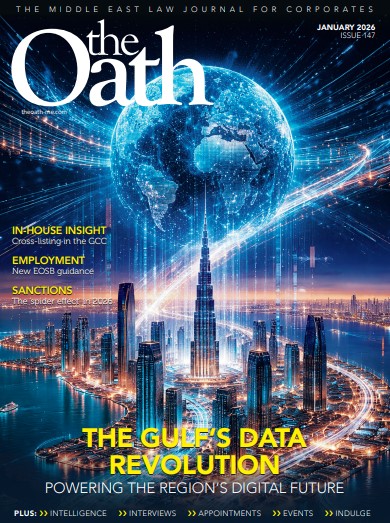





The Gulf’s data revolution
Powering the region’s digital future: Ayman Khaleq, Barbara Melby and Ksenia Andreeva of Morgan, Lewis & Bockius reveal why data centres are at the heart of the UAE and Saudi Arabia’s 2026 outlook.
As the global digital economy accelerates, data centres have moved from being a back-office necessity to a strategic national asset. Nowhere is this shift more evident than in the Gulf, where the United Arab Emirates (UAE) and Saudi Arabia are rapidly positioning themselves as global hubs for cloud computing, artificial intelligence, and digital infrastructure.
Over the last several years, both countries have executed ambitious national strategies designed to attract technology investment, build sovereign digital capacity, and support next-generation industries. In 2026, these efforts will reshape the data centre landscape in ways that are drawing unprecedented interest from hyperscalers, institutional investors, private equity sponsors, and regional operators alike.
Based on our experience advising cross-border investors and operators active in the region, several themes stand out in understanding where the Gulf data centre market is today—and where it is headed next.
FROM EMERGING MARKETS TO STRATEGIC DIGITAL HUBS
Until relatively recently, data centre development in the UAE and Saudi Arabia was largely opportunistic, with limited local demand and modest scale compared to North America, Europe, or parts of Asia. That picture has changed dramatically.
Over the last three years, both jurisdictions have transitioned from emerging markets into strategic regional hubs for digital infrastructure. Government-led digital transformation programs have been central to this shift. Saudi Arabia’s Vision 2030 agenda has placed technology, data, and digital services at the core of economic diversification, while the UAE has advanced national strategies focused on artificial intelligence (AI), cloud adoption, and smart government.
These policy frameworks have provided the predictability and momentum that global investors look for when deploying capital at scale. Hyperscale cloud providers have expanded aggressively, while regional operators have grown in sophistication and capacity. Sovereign wealth funds have played a catalytic role, deploying capital not only for financial returns but also to support technology transfer, local capability building, and long-term national objectives.
As a result, the market has moved beyond early-stage experimentation. Today, demand is driven by a broad mix of users, including multinational enterprises, financial institutions, fintech platforms, AI-driven businesses, and governmental entities seeking secure, low-latency, and sovereign-compliant infrastructure.
THE KEY DRIVERS BEHIND INVESTMENT MOMENTUM
Several interrelated factors are fueling the surge in data centre investment across the Gulf.
- Data localisation and sovereignty requirements have become a decisive factor. Regulators in both the UAE and Saudi Arabia increasingly require certain categories of data—particularly government, financial, and sensitive personal data—to be hosted locally. This has created structural demand for in-country capacity and has encouraged global providers to establish a physical presence rather than relying on offshore infrastructure.
- The rapid adoption of AI is fundamentally reshaping infrastructure requirements. AI workloads demand high-density compute environments, advanced cooling solutions, and resilient power supply—capabilities that were limited in the region just a few years ago. Today, both countries are actively positioning themselves to support AI-ready data centres, recognising that compute capacity is becoming as critical as energy or transportation infrastructure.
- Government support has lowered traditional barriers to entry. Investor-friendly policies, streamlined licensing processes, and free-zone incentives have made it easier for foreign investors to structure and execute complex projects. In parallel, regulators have shown increasing sophistication in balancing national interests with the need to remain competitive in attracting global capital.
- The Gulf’s ability to meet the power demands of hyperscale data centres has become a significant differentiator. Access to reliable, scalable energy—combined with growing investment in renewables—has allowed the region to support large-scale developments that might face constraints elsewhere.
Together, these factors have positioned the UAE and Saudi Arabia among the most attractive global growth markets for new data centre builds.
NAVIGATING COMPLEXITY: CHALLENGES FOR NEW ENTRANTS
Despite strong fundamentals, entering the Gulf data centre market is not without challenges. Investors should navigate the complex set of technical, regulatory, and commercial considerations with careful planning and local insight.
Power and water availability remain central concerns, particularly for AI-focused facilities with high-density requirements. While overall capacity is strong, long-term pricing, sustainability commitments, and infrastructure integration should be addressed early in the development process.
Land acquisition and zoning present additional complexities. Securing suitable sites with long-term tenure can be competitive, especially in key metropolitan areas. In Saudi Arabia, demand has outpaced supply in certain locations, requiring investors to engage early with authorities and consider alternative regions aligned with national development priorities.
Regulatory compliance is another significant factor. Data protection regimes, cross-border transfer restrictions, and foreign ownership rules can significantly influence project structure. These issues often intersect with financing considerations, particularly where projects involve multiple capital sources, co-investors, or international fund structures.
Successful investors also recognise the importance of partner selection. From engineering, procurement, and construction contractors to long-term operators, the ability to deliver on aggressive timelines while maintaining quality and compliance is essential. Many of the most effective market entrants form strategic alliances early and localise their delivery models to align with regulatory and cultural expectations.
Large-scale data centre investments in the region often require sophisticated private placement structures spanning multiple jurisdictions. Coordinating these elements adds another layer of complexity but is increasingly common as the market matures.
WHERE THE OPPORTUNITIES LIE THROUGH 2026 AND BEYOND
Looking ahead three to five years, the Gulf data centre market is expected to continue its rapid evolution, with several areas standing out as particularly compelling.
AI-optimised facilities are likely to be at the forefront. As governments and enterprises deploy AI across sectors—from healthcare and finance to logistics and smart cities—the need for specialised infrastructure will accelerate. Investors capable of delivering high-density, energy-efficient solutions will be well positioned to capture this demand.
Edge deployments also present significant opportunities. As latency-sensitive applications expand, capacity closer to end users will become increasingly valuable, particularly for gaming, fintech, and real-time analytics.
Hybrid public–private solutions are another area of growth, especially for government workloads that require both scalability and control. Partnerships between public entities and private operators are expected to increase, creating opportunities for investors who can navigate both commercial and regulatory environments.
Geographically, Saudi Arabia is likely to see substantial build-out beyond traditional hubs, aligned with Vision 2030 mega-projects and secondary cities. The UAE, meanwhile, will continue to attract global operators seeking a gateway to the broader Middle East, Africa, and South Asia.
Across both markets, sustainability will be a defining theme. Investors who integrate energy efficiency, renewable power, and innovative cooling technologies into their designs will not only meet regulatory expectations but also gain a competitive advantage as customers place greater emphasis on environmental performance.
A MARKET ENTERING ITS NEXT PHASE
The UAE and Saudi Arabia are rapidly becoming global hubs for digital infrastructure and AI-ready data centres. The foundations have been laid through policy, capital deployment, and infrastructure investment. What comes next will be defined by execution, innovation, and the ability to scale responsibly.
For investors, operators, and technology companies, the Gulf offers a rare combination of demand growth, government support, and strategic relevance. Those who understand the regulatory landscape, build strong local partnerships, and approach the market with a long-term perspective will find opportunities that extend well beyond individual projects.
As digital infrastructure becomes increasingly central to economic competitiveness and national security, the Gulf’s role in powering the global digital future is only just beginning.
Text by:

- Ayman A. Khaleq, partner & co-leader of Middle East practice, Morgan, Lewis & Bockius LLP
- Barbara Murphy Melby, co-leader of data centers strategic initiative, Morgan, Lewis & Bockius LLP
- Ksenia Andreeva, partner, Morgan, Lewis & Bockius LLP