




The Corridor’s capital catalyst

CAM Middle East and Apex Group talk about how the Middle East situation is reshaping the GIFT City opportunity, as investors prioritise structured exposure, jurisdictional flexibility and risk-managed access to India-linked growth.
Recent tensions in the Middle East have spilt beyond their immediate geography. Across trade corridors, capital markets, family offices and fund structures, the second-order effects are now visible in pricing, deal velocity and an increase in jurisdictional choice. Among the financial centres attracting this attention, GIFT City, India’s only onshore international financial services centre, has moved quickly from prospect to participant. The mood across Mumbai, Ahmedabad, Singapore and the UAE in recent weeks is one of recalibration rather than retreat. Investors are pausing, reassessing, and quietly repositioning. In that calculus, GIFT is increasingly part of the answer, not for everyone, and not as a substitute for established Gulf jurisdictions, but as a credible counterpart in a corridor that is growing more sophisticated.
This article examines the key trends shaping deal-making, capital flows, real estate, maritime law, private equity, and emerging sectors and asks what this moment means for the India-Middle East financial corridor and for GIFT City’s evolving role within it.
The Macro Picture: Caution Without Capitulation
One signal worth attending to has been the selective invocation of force majeure clauses in institutional and government-linked arrangements. These remain rare, but each instance provides insight into how counterparties are interpreting the current environment. When sovereign-adjacent structures invoke such clauses, even if only occasionally, the market reads the dislocation as anything but transient.
That uncertainty is translating into caution. Investors are reassessing exposure to the Middle East, gravitating towards short-term deals, resetting existing arrangements, and realigning valuations. Many investors now prefer to pause and recalibrate pricing and timing rather than commit to long-term positions.
This is not a retreat from the Middle East. Instead, it is a shift towards discipline and a more sophisticated, risk-adjusted deployment strategy. Institutional investors, including sovereign wealth funds, family offices, and private equity players, are weighing entry positions with greater care. In a region defined by high deal velocity, this caution marks a meaningful behavioural shift.
Middle East Capital and Its Movement Towards India and GIFT
Perhaps the most consequential trend for the India-Middle East corridor is the directional movement of capital from the Gulf towards India.
Sovereign wealth funds and other Middle Eastern investors in India are showing growing interest, though structures currently appear largely offshore. No major structural shift has yet occurred, but early signals reflect a crucial distinction: interest is building, but the architecture to support it is still being designed.
Meanwhile, other funds remain focused on UAE-based investments, including infrastructure. This bifurcation of capital, with some pivoting eastward and others doubling down on the UAE, reflects the heterogeneity of Middle Eastern institutional capital and the absence of a single, monolithic response to current conditions.
For GIFT City, this moment presents an early-mover opportunity. Increasingly viewed as a potential hub for pooling and structuring India-linked investments, GIFT offers the flexibility and indirect-exposure structures that appeal to investors navigating uncertainty. As Middle Eastern sovereign funds and institutional investors seek routes into Indian assets that offer regulatory clarity, tax efficiency, and a familiar international framework, GIFT City’s architecture, modelled on global IFSCs and governed by the IFSCA, becomes a compelling proposition.
Shari’ah overlay: A precondition, not an enhancement
GIFT City’s regulatory framework is sufficiently flexible to accommodate Shari’ah-compliant fund structures, with the IFSCA (Fund Management) Regulations, 2025 enabling strategy-specific overlays—such as Shari’ah screening, governance, and investment restrictions—through a disclosure-based approach.
Saudi flow: The under-discussed half of the corridor
The corridor is increasingly trilateral rather than bilateral. Saudi institutional capital, deployed by SAMA-regulated allocators and CMA-licensed managers, is showing growing interest in India, accelerated by Saudi Vision 2030 diversification objectives and an expanding Saudi private funds regime. India’s GIFT-City fund vehicles offer Saudi LPs a regulated, internationally aligned onshore counterpart that aligns with Saudi-resident family office requirements. Indian managers and family offices alike are increasingly looking at Riyadh and Dammam not only as sources of capital but also as destinations, supported by SAMA’s evolving framework for foreign managers and CMA’s investment manager regime.
India’s Approach to Middle East Exposure: Structured Caution
The flow of capital is not solely from the Middle East into India. Indian investors, too, have meaningful exposure to and interest in Middle Eastern markets. Yet, at least for now, Indian non-institutional investors, family offices, and HNIs are holding back on direct exposure to the Middle East as they watch developments unfold. Instead, emerging in its place is a preference for pooled, structured exposure via GIFT rather than direct investments, reflecting a more cautious, structured, and shared-risk entry strategy.
This is a defining moment for GIFT City. It is no longer merely a domicile for foreign investment into India, but it is emerging as a two-way structuring gateway that enables Indian capital to access international markets, including the Middle East, through a regulated, structured, and tax-efficient framework. This distinction matters enormously for how GIFT should be positioned to both domestic and international stakeholders.
Institutional Capital Flows: India Inc. Doubles Down on the UAE
Reserve Bank of India ODI data for Q1 2026 shows Indian corporate deployment into UAE entities running materially above the prior-year run rate, with March 2026 figures particularly elevated. Monthly ODI data is inherently lumpy, and a single transaction can move the headline. The trend across the quarter, however, is consistent with sustained corporate conviction rather than tactical positioning and is corroborated by activity at the larger fund administrators and corporate banks operating across the corridor.
This underscores a classic bifurcation in capital behaviour. While risk-off sentiment has prompted certain categories of investors, particularly HNIs and smaller family offices, to pause and recalibrate, institutional and corporate capital continues to flow into the UAE with conviction. For large Indian corporates, the UAE’s position as an anchor jurisdiction remains structurally intact, whether for holding structures that facilitate global investments or for regional strategic joint ventures.
For GIFT City, this trend reinforces its relevance as a structuring jurisdiction at the heart of the corridor. As Indian corporates continue to scale their UAE operations and capital flows intensify in both directions, the demand for efficient pooling vehicles, holding structures, and risk-managed investment platforms, all of which GIFT is designed to facilitate, is only likely to grow. Far from signalling a retreat, these trends underscore the depth and durability of the India-UAE economic relationship and the strategic imperative for GIFT to serve as the financial infrastructure backbone of this relationship.
There is a corporate treasury dimension to this that is rarely discussed in public commentary. Indian conglomerates with material operations in the UAE increasingly face questions about where to pool surplus liquidity, how to structure intra-group financing across the two jurisdictions, and how to hold joint-venture interests in tax-efficient and disclosure-coherent ways. GIFT-side pooling vehicles and IFSCA-regulated treasury constructs are now operationally workable answers to these questions, though they require structuring rather than improvisation. The advisers who have run this work end-to-end can materially shorten the path.
Real Estate: Yield Over Velocity
Real estate has long been a cornerstone of the India-Middle East investment relationship, with the Indian diaspora constituting one of the largest real estate owning nationalities in the UAE. The current situation has introduced new variables.
Demand continues for yield-based, central real estate assets, supported by the movement of families and capital, as well as the UAE’s golden visa programme. For families weighing long-term residency and mobility options, real estate acquisition serves both an investment and a lifestyle function.
Yet actual inflows from India into the UAE real estate market are witnessing a relative downturn despite the strong but cautious sentiment, as buyers anticipate price corrections and revaluations. This pause reflects a search for a new equilibrium rather than a retreat, with informed buyers waiting for valuations to align with revised risk assessments.
In this environment, GIFT-based fund structures are positioned as providing flexibility, though investors are not making any sudden moves. Some master-feeder fund structures at GIFT offer Indian investors an alternative, professionally managed, diversified, and shared-risk access to UAE real estate opportunities.
Family Offices and Relocation: A Wait-and-Watch Approach
Family offices, particularly the large, sophisticated ones that operate across the India-Middle East corridor, represent some of the most mobile pools of global capital. Relocation is therefore a question with significant implications, although the current picture is nuanced. Family offices are increasingly considering jurisdictional optionality across GIFT, ADGM, DIFC, and Singapore. The choice typically tracks mandate composition rather than geopolitics. The approach is more one of wait-and-watch, and the calculus is significantly dependent on the entity’s size and scale.
For smaller family offices, relocation barriers are proportionally higher, with the compliance infrastructure, talent, and operational costs of establishing a presence in a new jurisdiction weighing significantly relative to the pool of assets being managed. For larger offices, relocation is more about optionality: building a parallel structure for geographic diversification without necessarily abandoning the primary base.
GIFT City has an opportunity here. With India’s growing wealth management ecosystem, family office structuring, and regulatory support from the IFSCA, GIFT is well-positioned as an attractive domicile for family offices seeking India connectivity. Whether originating in the Middle East or in the Indian diaspora across the Gulf, the key is to demonstrate operational maturity and talent availability, areas where GIFT is actively developing.
There is a separate succession dimension that is increasingly material. ADGM Foundations and DIFC Prescribed Companies have become standard wrappers for multi-generational structures with India connectivity, with GIFT-side family investment funds emerging as the natural Indian-side counterpart. The most thoughtful families are running these in parallel rather than choosing between them. The choice typically tracks mandate composition: India-centric platforms gravitate toward GIFT and ADGM; globally diversified mandates favour Singapore and DIFC; multi-generational structures with significant succession-planning needs increasingly look to ADGM Foundations or DIFC Prescribed Companies as a settlor-side wrapper, with operational fund and asset-management activity sitting in GIFT or ADGM, as appropriate.
Flow of Funds: Structuring Capital Into and Out of India
A critical element in the India–Middle East corridor is the efficient structuring of capital flows, both inbound into India and outbound from India. For foreign investors, capital can be deployed into India either directly via FDI/FPI routes or through pooled vehicles established in GIFT City, which act as regulated offshore-equivalent jurisdiction within India’s physical borders providing tax efficiency and familiarity of global fund structures.
For outbound investments from India, two primary routes are relevant: OPI (Overseas Portfolio Investment) for listed and financial assets, and ODI (Overseas Direct Investment) for strategic or controlling stakes. Additionally, individuals can utilise the Liberalised Remittance Scheme (LRS) for offshore allocations, which can be routed into GIFT City-based funds to achieve diversification while remaining within a regulated framework.
GIFT City plays a pivotal role as a two-way conduit, enabling capital to be pooled offshore, deployed into India, and repatriated efficiently. Indian investors can also use GIFT structures to access global opportunities without direct offshore structuring complexity. From a repatriation standpoint, distributions can flow back through fund structures in a tax-efficient manner, subject to applicable Indian tax and FEMA regulations.
Increasingly, we are seeing hybrid structures (GIFT + ADGM/DIFC/Cayman) being used to optimise investor familiarity, regulatory clarity, and capital mobility across jurisdictions. The key is not simply access, but structuring flows in a way that balances compliance, tax efficiency, and operational flexibility across the full investment lifecycle.
GIFT As a Jurisdiction: Strategic Positioning for the Corridor
These trends reflect that GIFT City is being stress-tested by real-world conditions and, by and large, demonstrating relevance. This relevance is not theoretical; it is validated by actual investor behaviour, deal-structuring preferences, and the directional movement of capital across the corridor.
GIFT has steadily positioned itself as a potential hub for pooling and structuring both India-linked and India-outbound investments, with growing relevance among investors seeking flexibility and indirect exposure structures. Its strength lies in its ability to serve as a two-way gateway: facilitating the flow of Middle Eastern capital into Indian assets while enabling Indian investors to access international opportunities through regulated, tax-efficient vehicles. This distinguishes it from competing jurisdictions that tend to serve only one side of the corridor. As the current environment continues to reward structured, risk-mitigated approaches over direct deployment, GIFT’s proposition is likely to strengthen further on the back of the Middle East conflict.
A useful test is whether GIFT’s relevance would endure if regional conditions stabilised faster than expected. The honest answer is yes, but for different reasons. GIFT’s longer-term proposition is not safe-haven status; it is structural efficiency: regulatory predictability, an expanding professional ecosystem and a tax-and-foreign-exchange framework designed for cross-border capital. The right way to think about the corridor is not replacement but rebalancing. The UAE remains the right answer for situations where scale, neutrality and ecosystem depth are decisive. GIFT is increasingly the right answer for India-centric funds, family-office platforms with India connectivity, treasury pools needing INR-rupee-international-currency interoperability and structures where regulatory proximity to Indian markets is an advantage rather than a drawback. Most sophisticated families and managers will run both. GIFT competes not on cost or tax alone but on legal design, regulatory coherence, and strategic relevance for India-linked capital, which is a far more durable basis for building a cross-border platform.
What This Means for Stakeholders in the Corridor
For businesses, investors, and advisers operating in the India-Middle East corridor, the current moment calls for a combination of vigilance and strategic opportunism.
For Middle Eastern sovereign and institutional investors, the window to explore GIFT-based structures is open. Early engagement allows for relationship-building with regulators, legal advisers, and fund managers before the market matures and pricing normalises.
For Indian corporates and investors with Middle East exposure, the preference for pooled, structured approaches via GIFT reflects sound risk management. Evaluating appropriate structures, whether funding or special-purpose vehicles, will be essential.
For family offices in the corridor, the wait-and-watch approach is understandable, but the planning horizon should extend beyond the current cycle. Evaluating GIFT, Singapore, and other jurisdictions now, even without an immediate decision, will position families to move quickly when conditions clarify.
Conclusion: A Moment of Calibrated Repositioning
The situation in the Middle East is not a crisis for the India-GIFT-Middle East corridor. It is a catalyst accelerating conversations that were already underway about where capital should be structured, where families should be domiciled, and which jurisdictions offer the right combination of regulatory quality, market access, and long-term stability.
GIFT City’s moment is arriving incrementally rather than dramatically, which is the right pattern for a jurisdiction building durable institutional relationships. The watchlist for the next twelve to twenty-four months is straightforward: the pace of IFSC fund formation, the depth of IFSCA’s MoU framework with FSRA, DFSA, and SAMA, sovereign-anchor pilot allocations, and the first wave of family-office relocations that follow committed capital rather than precede it. Indian families, fund managers and corporates who engage with this architecture now will help shape it. Those who wait will inherit it. The architecture is being built; the question is which seats at the table will already be occupied when the seating chart is finalised.
Text by:
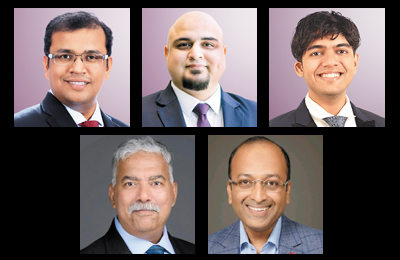
- Subhojit Sadhu, partner (finance & infrastructure) and director, CAM Middle East
- Himanshu Chahar, partner (corporate) and director, CAM Middle East
- Keertesh Tripathi, associate, Cyril Amarchand Mangaldas
- Bhaskar Dasgupta, chairman of the board, FundRock ADGM and global head of market development, Apex Group
- Mohit Gupta, senior vice president & head of sales – GCC, Apex Group