




R&D Tax Incentives

The UAE has introduced an R&D Tax Credit regime effective 2026, enabling businesses to offset qualifying expenditure against corporate and top-up taxes with key conditions and planning considerations already emerging, writes emltc.
The UAE has been making multiple updates to its legal framework relating to technological updates and technology-based governances. These include e-Invoicing, the Federal Virtual Assets Framework, the Personal Data Protection Law, etc. Following the same direction, the UAE recently introduced the so-called Research & Development Tax Credit regime (“R&D Tax Credit Regime”) under its Corporate Tax Law framework. This was meant to offer a higher credit rate for those taxpayers making substantial investment in R&D and hiring staff for this purpose.
The incentives:
The tax credit mechanism has been announced through Cabinet Decision No. 215 of 2025 and Ministerial Decision No. 24 of 2026. These apply from tax period January 1, 2026, onwards. The non-refundable tax credits apply as follows:
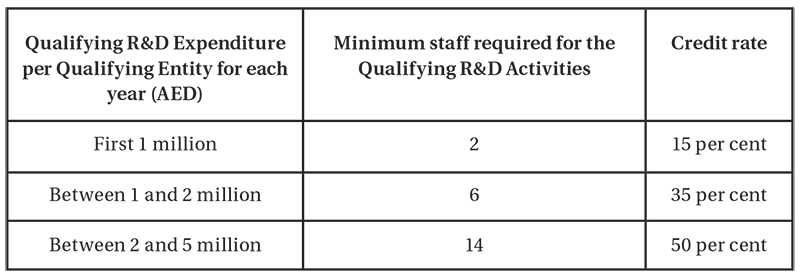
These R&D Tax Credits may be utilised against Corporate Tax and/or Top-up Tax liability of the Qualifying Entity. It can also be carried forward to future years. Further details will be announced regarding transfer of R&D Tax Credits, including instances of business restructuring and documentation thereof.
The Qualifying R&D Expenditure include:
- Staff costs (including a 30 per cent markup);
- Consumable costs;
- Subcontracting fees;
- Arm’s Length Share under cost contribution arrangements.
Special rules are also provided for evaluating these costs. Likewise, rules also exist for the application of R&D Tax Credits to Tax Groups, as well as Domestic Groups under the UAE’s Pillar Two regime.
The Qualifying R&D Activities must be conducted within the UAE as a part of an R&D Project. It needs to meet the following international standards under the OECD Frascati Manual:
- Novelty (should produce new findings);
- Creativity (original concepts or hypotheses);
- Uncertainty (the outcome is not known in advance);
- Systemised (a plan and a budget followed);
- Transferability/reproduction (results can be applied or replicated).
The Qualifying Entity must also:
- Obtain the necessary preapprovals from the Emirates Research and Development Council (“Council”);
- Bear the financial burden of carrying out the Qualifying R&D Activities;
- Be entitled to a share of the returns derived from exploiting the results;
- Ensure that:
- The R&D Project has a specified objective to increase the stock of knowledge or devise new applications of available knowledge and
- The Qualifying R&D Activities are directly undertaken to achieve this objective.
- If a Qualifying Free Zone Person, be subject to 9 per cent Corporate Tax or be subject to Top-up Tax during the period of incurring the Qualifying R&D Expenditure.
Documentation and backstop:
Qualifying Entities must maintain technical documentation to justify undertaking the Qualifying R&D Activities for a period of 7 years. These include written, visual and electronic records detailing the objectives, processes, methodologies, experiments and findings relating to the Qualifying R&D Activities.
Some of the information required to submit an application for the R&D Tax Credit include:
- Proof of obtaining pre-approval from the Council;
- Signed declaration by the Senior Management confirming the accuracy of the information;
- Breakdown of Qualifying R&D Expenditure;
- Audited financial statements.
Likewise, businesses shall not artificially separate their Business or Business Activity to claim the R&D Tax Credit without a valid commercial purpose. If so, the arrangement may be counteracted, clawed back or forfeited.
Special emphasis is also given on ensuring that the R&D Tax Credits have not been abused and are consistent with the economic substance and genuine nature of the Qualifying R&D Activities.
Impact on research-heavy businesses:
Offering R&D Tax Credits to UAE businesses investing in R&D has been as per the international best practices. A mandatory pre-approval of the Council has also been envisaged. Further details (form, manner and timelines) will be specified in due course.
Noteworthy that the R&D Tax Incentives is an input-based incentive (expenditure-based) and not strictly an output-based incentive (income-based, such as some of the older Patent-box regimes). Under international standards, the incentives are unlikely to be considered ‘Harmful’ to other states’ erosion of tax base.
Likewise, another major advantage of the R&D Tax Incentives is that they cannot only be set off against the regular Corporate Tax liability (headline 9 per cent), but also the Top-up Tax liability under Pillar Two (headline up to 15 per cent, applicable only to very large global businesses operating in the UAE). This means that some large MNEs that might have been exposed to a higher effective tax rate in the UAE can potentially have their liabilities credited if they qualify under this incentive.
Further information relating to approvals, documentation etc. will be revealed in due course. For now, businesses seeking this benefit from 2026 onwards are encouraged to organise their data, plans and expenditure budgets such that an estimated benefit may be arrived upon. This will also help in obtaining faster approvals when the window for the Council’s pre-approval opens. Likewise, large MNEs in the UAE that are modelling their Top-up tax liabilities for 2026 onwards would like to factor the estimated R&D tax incentives to estimate their overall tax liabilities in the UAE.
Text by:

- CONSTANTIN FRANK-FAHLE, LL.M., founding partner, emltc (Emerging Markets – Legal. Tax. Compliance.), Abu Dhabi/Dubai, UAE
- MARCEL TROST, founding partner, emltc (Emerging Markets – Legal. Tax. Compliance.), Abu Dhabi/Dubai, UAE
- VARUN CHABLANI, M., ADIT (CIOT, UK), senior associate, emltc (Emerging Markets – Legal. Tax. Compliance.), Abu Dhabi/Dubai, UAE